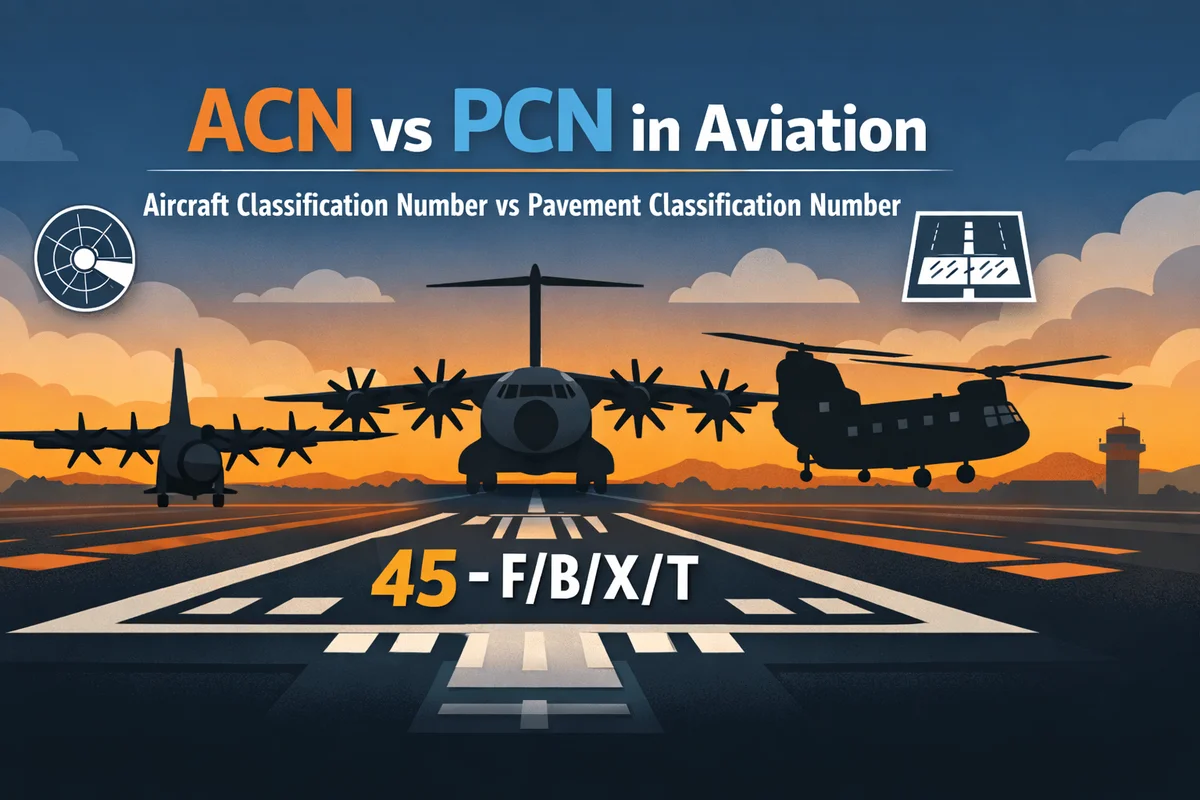
If you operate military or tactical aircraft into mixed-use airfields, one of the fastest ways to avoid runway, taxiway, and apron surprises is understanding ACN.
ACN (Aircraft Classification Number) is the aircraft-side pavement “demand” number. It’s designed to be compared with PCN (Pavement Classification Number), the airfield-side pavement “capacity” code published for runways, taxiways, and aprons.
When people say “check ACN/PCN,” they mean: Is this aircraft, at this weight, suitable for this pavement—here, today?
What ACN actually tells you
ACN is not one fixed value per aircraft. It changes with:
-
Aircraft weight (MTOW vs a lighter landing/tactical weight can change ACN a lot)
-
Pavement type: Flexible (asphalt) vs Rigid (concrete)
-
Subgrade strength category: A / B / C / D (A = strongest, D = weakest)
-
Gear layout and tire pressure
That’s why ACN values are typically shown as sets (e.g., flexible A/B/C/D and rigid A/B/C/D).
What PCN looks like (and how you use it)
A typical published PCN looks like:
PCN 50/F/B/X/T
Quick decode:
-
50 = strength number
-
F (flexible) or R (rigid)
-
A/B/C/D = subgrade category
-
W/X/Y/Z = allowable tire pressure category (W is least restrictive)
-
T (technical evaluation) or U (based on experience/usage)
The rule of thumb
-
ACN ≤ PCN (matching pavement type/subgrade) → usually acceptable for unrestricted operations
-
ACN > PCN → may require weight limits, movement limits, engineering approval, or a different parking/apron option
Military aircraft examples (how to think about A400M, C-130, Chinook, CH-53)
Rather than betting on a single “internet ACN number,” the safe, operationally correct approach is:
1) C-130 (H/J family)
-
Often used as a baseline tactical airlifter for pavement planning.
-
ACN varies strongly by weight and by flexible vs rigid pavement.
-
Practical takeaway: if your airfield routinely supports C-130 at high weight, it often supports many medium tactical types—but not automatically at maximum weights or on weak subgrades.
2) A400M Atlas
-
Heavier and different landing gear/loading characteristics than a C-130.
-
ACN can be notably higher at certain weights, especially on weaker subgrades.
-
Practical takeaway: don’t assume “we can take a C-130, so we can take an A400M.” You must compare the correct A400M ACN (at planned weight) to the published PCN.
3) CH-47 Chinook
-
For pavement classification, the big question is usually ground operations (wheels on taxiway/apron/spot), not rotor thrust.
-
Practical takeaway: ACN/PCN helps with structural pavement suitability; you still need separate checks for FOD, rotor wash, and surface condition.
4) CH-53 (E/K)
-
Heavier than Chinook in many configurations; often more demanding on parking areas/spots depending on weight and tire/gear setup.
-
Practical takeaway: even when runway PCN is fine, apron/stands/helispots can be the limiting factor—always check the specific pavement section PCN.
Where crews and planners often find PCN in Europe (Germany-focused)
For many European airfields, PCN information is commonly found in the state’s AIP (Aeronautical Information Publication) under the aerodrome (AD) section and sometimes in aerodrome charts / remarks. Military fields may also have additional national/NATO documentation.
If you’re operating in Germany, use keywords like:
-
“AIP Germany PCN runway”
-
“Berlin PCN apron” (if searching airport-specific operational notes)
-
“NATO ACN PCN military airfield Germany”
(Exact placement varies by state and aerodrome, but “AIP + airport name + PCN” is usually the fastest search pattern.)
Practical ACN/PCN checklist (operators & dispatch)
Use this before you launch:
-
Identify the exact pavement you’ll use (runway vs specific taxiway vs apron stand)
-
Confirm the published PCN for that pavement
-
Get the aircraft ACN at your planned operating weight (manufacturer data / official tables / approved engineering tools)
-
Match pavement type + subgrade category (F/R and A/B/C/D)
-
Check tire pressure category (W/X/Y/Z) and any local restrictions
-
If ACN is close to or above PCN: coordinate with airfield engineering/ops for mitigations (lower weight, reduced turns, limited repetitions, alternate parking)


// No pilot reports received — stand by.