Why this topic matters
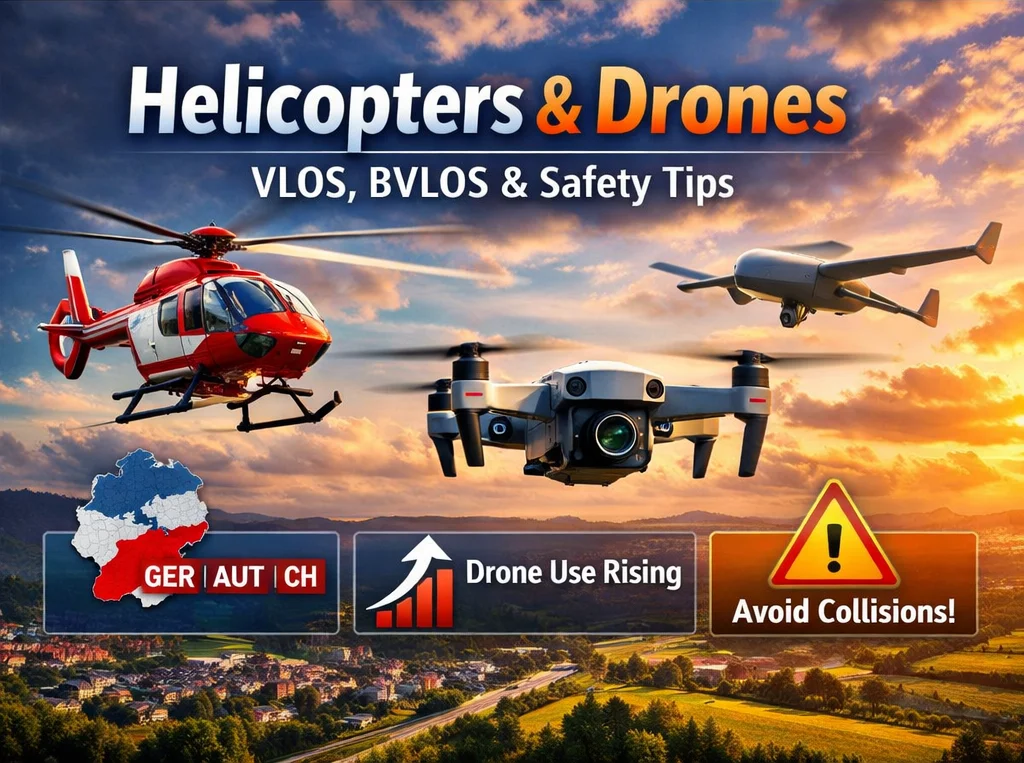
Drones are booming across Germany, Austria, and Switzerland—filming, inspections, mapping, agriculture, emergency response. Helicopters also operate where drones fly: very low level, often unexpectedly (HEMS/air ambulance, police, heliports, work flights). That overlap is where near-misses happen—and manned pilots may not see a small drone in time, so drone pilots must be prepared to yield immediately. The Swiss FOCA/BAZL explicitly states that manned aviation has priority and that drone pilots must keep enough distance because aircraft pilots have little chance to detect drones early. Bundesamt für Zivilluftfahrt
Drone types: “normal” (VLOS) vs BVLOS
VLOS (Visual Line of Sight)
VLOS means the remote pilot keeps the drone in sight and continuously scans the airspace. Switzerland’s rules for the open category emphasize VLOS and explain BVLOS is not allowed there. Bundesamt für Zivilluftfahrt
BVLOS (Beyond Visual Line of Sight)
BVLOS means flying beyond the pilot’s direct visual contact. In Europe, BVLOS typically sits in the Specific category and requires risk assessment/authorization and mitigations. EASA guidance mentions airspace observers as a tactical mitigation to detect manned aircraft entering the operational area and warn the remote pilot. EASA
Practical size buckets
-
Micro (<250 g) – travel and hobby, but still a collision hazard
-
Small (250 g–2 kg) – common camera drones
-
Medium (2–25 kg) – industrial mapping/inspection/BOS
-
Heavy (>25 kg) – specialized operations, closer to certified concepts
What drones are used for (and why helicopters care)
Common drone missions: photo/video, roof/PV inspections, powerline/wind inspections, surveying, agriculture monitoring, and public safety. These often happen near roads, cities, and incident scenes—exactly where helicopters may arrive for emergency or police missions.
DACH stats: registrations show strong growth
Germany: LBA operator registration statistics show growth from 357,000 (2021) to 705,840 (2024) registered UAS operators—roughly doubling in three years. lba.de
Germany also cites operational volumes of about 115,000 UAS operator registrations and ~56,000 A1/A3 competency certificates per year. digitale-verwaltung.de
Austria: Austro Control reported 45,000 registered drone operators and 70,000 drone certificates since the EU framework started (end of 2020). austrocontrol.at
Its 2024 annual report references about 61,500 drone operators (continued growth). austrocontrol.at
Switzerland: By end of 2023 there were nearly 70,000 registered operators reported publicly, then >80,000 in mid-2024, and official documentation references about 90,000 registered drone pilots (Oct 2024). cockpit.aero+2Admin News+2
Typical helicopter–drone conflict scenarios
-
Air ambulance (HEMS): fast arrival, very low approach/landing
-
Police/Fire: orbiting/search patterns over towns
-
Heliports/Hospitals: frequent low-level routes near pads
-
Work flights: powerline inspection, lifting operations
-
Training/low-level corridors: depending on region
What should a drone pilot do if a helicopter is coming closer?
Across DACH, the principle is clear: manned aircraft always have right of way (explicitly stated by Swiss FOCA/BAZL; also taught in German training material). Bundesamt für Zivilluftfahrt+1
Immediate actions (simple and safe):
-
Yield immediately.
-
Descend and land as soon as safely possible (if in doubt: land).
-
Do not climb and don’t “dash across” the helicopter’s path.
-
If you can’t land instantly, move laterally away while reducing altitude, then land.
-
If there’s an emergency response/blue-light operation nearby, land without delay (explicitly required in Switzerland). Bundesamt für Zivilluftfahrt
-
Abort the flight and reassess airspace constraints before relaunching.
For BVLOS, only operate with a robust concept: observers/monitoring and defined “manned aircraft incursion” procedures (EASA discusses airspace observers as a mitigation). EASA
What drone users should know about aviation & low-level flights
-
120 m (400 ft) AGL isn’t “helicopter-free.” Helicopters may operate low for legitimate reasons.
-
Use official geo-zone tools before every flight:
-
Germany: DFS points to Droniq Maps for flight planning in Germany. DFS Deutsche Flugsicherung GmbH+1
-
Austria: Austro Control Dronespace includes quick-check and controlled-zone coordination features. dronespace.at+1
-
Switzerland: FOCA/BAZL drone map guidance is available via geo.admin and BAZL pages. geo.admin.ch+1
-
-
Assume the helicopter cannot see your drone—plan so you can get out of the way instantly. Bundesamt für Zivilluftfahrt
SEO + GEO FAQ (EN)
What does BVLOS mean?
BVLOS = Beyond Visual Line of Sight: flying where the pilot cannot maintain direct unaided visual contact. In Switzerland’s open category, BVLOS is not allowed. Bundesamt für Zivilluftfahrt
UAV vs UAS – what’s the difference?
UAV is the aircraft; UAS is the whole system (aircraft + control station + links + operation).
How many registered drone operators are there in Germany?
LBA statistics list 705,840 registered UAS operators for 2024. lba.de
What are the latest Austria numbers?
Austro Control reported 45,000 registered operators (2023) and its 2024 annual report references ~61,500. austrocontrol.at+1
What should I do when a helicopter approaches?
Give way: reduce altitude and land immediately if safe; when in doubt, land and abort. Bundesamt für Zivilluftfahrt+1
Where can I check airspace restrictions locally?
Germany: Droniq/DFS; Austria: Dronespace; Switzerland: BAZL drone map on geo.admin. DFS Deutsche Flugsicherung GmbH+2dronespace.at+2
Comments (0)
No comments yet. Be the first to comment!